
Explore this post with your favourite AI tool:


Share this article with AI tools to summarise, remember, or explore the content further.
Implementing effective construction site security is a critical priority for contractors as the school holidays approach and the risk of unauthorised access by children increases. Failure to secure a site not only puts young lives at risk but leaves dutyholders open to significant regulatory scrutiny and legal liability.
The Health and Safety Executive (HSE) has issued a fresh warning to construction firms, urging them to review their boundary protection and site-access protocols. As schools break up, the regulator typically sees a rise in incidents involving children venturing onto sites, often unaware of the hidden hazards that remain even when work has finished for the day. For site managers and principal contractors, the message is clear: a fence is more than just a perimeter; it is a vital safety barrier that must be maintained and monitored.
Construction sites are naturally attractive to children, who may see scaffolding as a climbing frame or deep excavations as areas for play. However, the reality is far grimmer. The risks of falls from height, entrapment in unstable ground, or being crushed by falling materials are constant. The HSE has highlighted that while many sites have security measures in place, they are often compromised by poor maintenance, such as gaps in fencing or gates that are left unlocked after hours.
The legal and safety necessity of construction site security
Securing a site is not merely a matter of protecting assets and preventing plant theft; it is a statutory obligation. Under the Construction (Design and Management) Regulations 2015 (CDM), principal contractors are specifically required to take reasonable steps to prevent unauthorised access. This duty extends beyond the working day. If a child manages to enter a site and is injured because the perimeter was inadequate, the HSE will look directly at whether the dutyholder met their obligations to secure the premises.
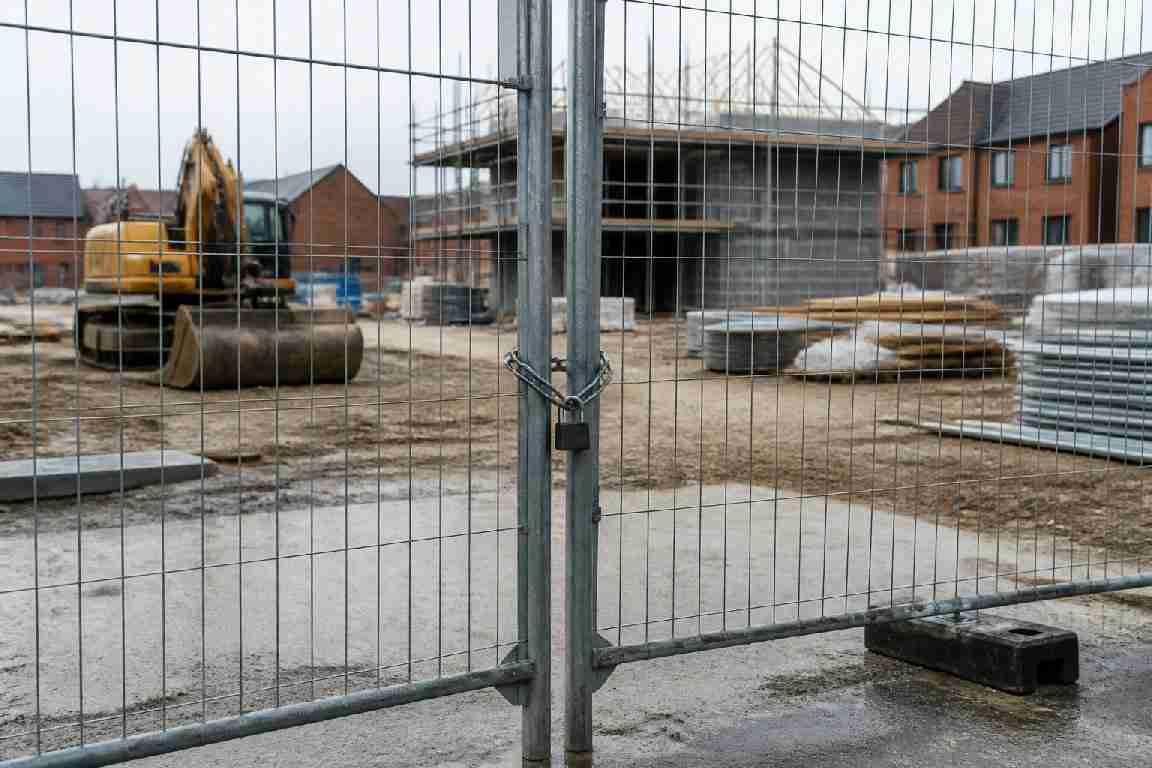
Effective construction site security requires a proactive approach to risk assessment. It is not enough to put up some Heras fencing at the start of a project and assume the job is done. Fencing can be moved by the public, damaged by high winds, or intentionally dismantled by those looking for a shortcut. Daily inspections of the site perimeter should be a standard part of the site supervisor’s routine, ensuring that every panel is clipped and every gate is secured before the last person leaves the site.
The regulator is particularly concerned about sites located in residential areas or near schools and parks. In these high-risk areas, standard fencing may not be sufficient. Contractors might need to consider more robust solutions, such as solid hoarding that is harder to climb, or enhanced CCTV monitoring to alert security teams to a breach in real-time. The goal is to make the site as unappealing and inaccessible to curious children as possible.
Managing common hazards for young trespassers
Beyond the perimeter, what stays inside the site also matters. The HSE advises that if construction site security is breached, the internal environment should be left in as safe a state as possible. This means lowering all excavator buckets to the ground, removing keys from plant machinery, and isolating power supplies. Scaffolding ladders should be removed or boarded over at the lower levels to prevent children from climbing to heights where a fall could be fatal.
Manholes and excavations are another major concern. These should be securely covered or fenced off internally. Even a relatively shallow trench can be a death trap if it collapses or fills with water. Drowning and suffocation are risks that are often overlooked until it is too late. By treating the site as if a trespasser is inevitable, managers can add layers of protection that mitigate the consequences of a security failure.
Materials storage also plays a role in site safety. Large pipes, timber stacks, and pallets of bricks should be stored on level ground and secured so they cannot be toppled. To a child, a stack of pipes looks like a tunnel to crawl through, but if they shift, the result can be catastrophic. Proactive site teams will ensure that heavy materials are stored away from the perimeter fence to prevent them from being used as a scaling aid to get over the top.
Practical steps for dutyholders and site managers
The financial and reputational cost of an accident involving a child is immense, far outweighing the cost of hiring a security guard or investing in better fencing. For facilities managers and landlords overseeing smaller refurbishment projects, the same rules apply. Even a small-scale scaffolding job on a high street requires a plan for construction site security to keep the public out of harm’s way. Just because a project is short-term does not mean the regulations are any less stringent.
Engagement with the local community can also help. Some firms find success by visiting nearby schools to talk about site safety or putting up clear, child-friendly signage that explains the dangers in simple terms. While signage is never a substitute for a physical barrier, it can act as a secondary deterrent. However, the ultimate responsibility for construction site security lies with those in control of the site; they must ensure that “out of sight, out of mind” never applies to the safety of the local community.
As the holiday period progresses, the HSE is expected to continue its focus on site boundaries during routine inspections. Inspectors will be looking for evidence that contractors have thought about the specific risks of their location and have a system in place to check and maintain their security measures. For those responsible for site safety, now is the time to walk the perimeter and ask: is this enough to keep a determined child out? If the answer is no, the site is not yet ready for the summer break.