Explore this post with your favourite AI tool:


Share this article with AI tools to summarise, remember, or explore the content further.
The adoption of construction smart wearables is rapidly shifting from a high-tech novelty to a practical necessity for firms looking to reduce onsite incidents. As site environments become more complex, these digital tools are providing safety managers with the granular data needed to protect workers in real time.
The UK construction industry continues to grapple with high rates of musculoskeletal disorders and falls from height. While traditional PPE remains the foundation of site safety, a new generation of connected technology is beginning to fill the gaps that manual supervision cannot always cover. From sensors that monitor vital signs to exoskeletons that reduce physical strain, the digitisation of the workforce is changing how risk is managed on the ground.
For several years, the industry has talked about the “connected jobsite” as a distant concept. However, recent developments in battery life and sensor accuracy have made these tools viable for daily use in harsh outdoor environments. By embedding technology directly into the gear workers already wear, such as boots, hats, and high-visibility vests, contractors are gaining visibility into hazards that were previously invisible until an accident occurred.
Improving incident response with construction smart wearables
One of the most immediate benefits of these devices is their ability to provide an instant alert when something goes wrong. Lone worker protection has long been an administrative headache for site managers, especially on sprawling infrastructure projects or multi-storey builds where workers may be out of sight for extended periods. Smart sensors can now detect a “man down” event via integrated accelerometers, automatically triggering an emergency alert with precise GPS coordinates.
Beyond emergency response, construction smart wearables are being used to prevent accidents before they happen. Proximity sensors attached to hard hats or waist belts can vibrate or beep when a worker gets too close to moving plant machinery or the edge of an unprotected leading edge. This creates a digital geofence—an invisible safety barrier that acts as a final fail-safe when a worker is distracted or enters a high-risk zone unintentionally.
Environmental monitoring is another area where these tools are proving their worth. On-body sensors can track the surrounding air quality, noise levels, and even the core body temperature of the wearer. In a summer where heat stress is becoming a more prominent concern for UK health and safety leads, the ability to pull a worker off a task before they suffer heat exhaustion is a significant step forward in proactive welfare management.
Addressing the burden of musculoskeletal disorders
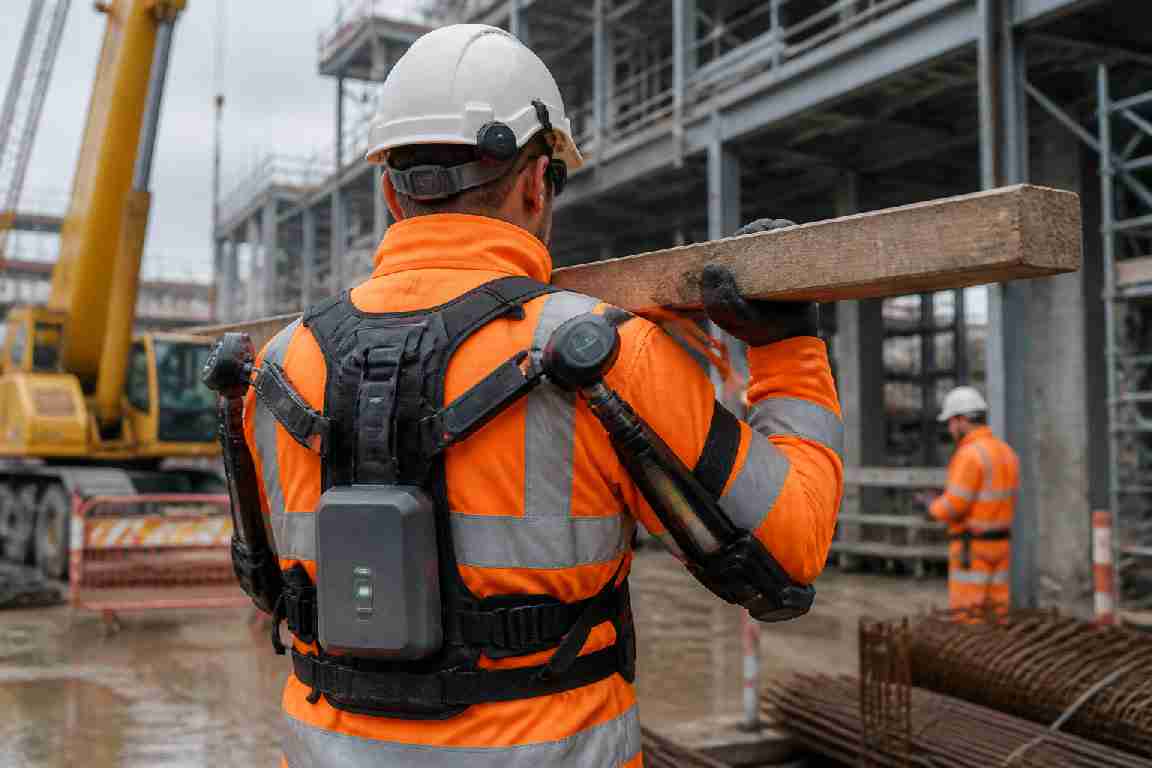
Manual handling remains one of the most common causes of long-term absence in the UK construction sector. While training and lifting aids are standard, the physical toll of repetitive tasks is hard to mitigate entirely. This is where powered and non-powered exoskeletons are beginning to make an impact. These wearable frames support the back, shoulders, or knees, offloading weight and reducing the physical effort required to hold heavy tools or perform overhead work.
Critics often argue that technology cannot replace a solid safety culture, and they are right. However, the data gathered by construction smart wearables provides a factual basis for culture change. When a safety manager can see a heatmap of where “near-miss” proximity alerts are happening on a site, they can redesign the site layout or traffic management plan based on evidence rather than guesswork.
This data-led approach aligns closely with the modern expectations of the Health and Safety Executive (HSE) and other UK regulatory bodies. Proactive risk management is no longer just about having the right paperwork; it is about demonstrating that risks are being actively monitored and controlled. Technology provides a digital audit trail that proves a dutyholder is taking every reasonable step to ensure worker safety.
Integration and privacy challenges for dutyholders
For facilities managers and contractors, the decision to invest in construction smart wearables comes with practical hurdles. There is the obvious capital expenditure, but the bigger challenge often lies in data management and worker privacy. Employees may be hesitant to wear devices that track their movements or physical health, fearing that the data will be used for performance monitoring rather than genuine safety improvements.
Overcoming this “Big Brother” perception requires transparent communication. Successful implementations usually involve clear policies stating exactly what data is collected, who sees it, and how it is used to improve site conditions. When workers understand that a vibration in their vest could save them from being struck by a reversing telehandler, the pushback tends to diminish.
There is also the question of interoperability. A site might have five different subcontractors, each using different safety platforms. For the principal contractor, the goal is to find a way to integrate these various streams of data into a single dashboard. As the market matures, we are seeing more “open” systems that allow different brands of wearables to communicate, making it easier to manage compliance across a diverse workforce.
Looking ahead, the role of construction smart wearables is likely to expand into health surveillance and long-term wellness. By monitoring exposure to vibration or silica dust over a period of months, these devices could help prevent the onset of occupational diseases that often take years to manifest. For now, the focus remains on the immediate: keeping people safe, keeping them upright, and ensuring they go home in the same condition they arrived in.