Explore this post with your favourite AI tool:


Share this article with AI tools to summarise, remember, or explore the content further.
Prioritising occupational health and safety is essential for high-hazard industrial environments, particularly when seasonal temperatures present significant risks to the workforce. Aluminium Bahrain (Alba), one of the world’s largest aluminium smelters, has launched its annual “Summer Safety and Health Campaign” to address these challenges and reinforce its long-standing safety culture.
The campaign, which has become a staple of the company’s operational calendar, focuses on the specific health risks associated with working in extreme heat. For a facility of this scale, manageing thermal stress is not just a welfare issue but a core operational requirement. The initiative aims to ensure that every employee and contractor returns home safely by providing practical education on heat exhaustion, hydration, and the importance of taking necessary breaks during peak temperature hours.
Industry leaders often look to large-scale smelters like Alba for benchmarks in risk management. The smelter’s approach combines top-down leadership with boots-on-the-ground engagement. Throughout the campaign, senior management and board members are expected to conduct site visits, interacting directly with workers on the shop floor to verify that safety protocols are being followed and that the “Safety First, Prosperity Follows” ethos is understood at all levels.
The role of leadership in occupational health and safety
One of the most effective ways to drive compliance is through visible felt leadership. When executives move away from their desks and onto the production line, it sends a clear message that safety performance is valued as highly as production targets. For those tasked with manageing occupational health and safety in the UK, this serves as a reminder that a safety culture cannot be sustained through policy documents alone; it requires consistent, visible reinforcement.
At Alba, this year’s campaign is particularly focused on “Self-Care” and “Collective Responsibility.” By encouraging workers to look out for one another, the company aims to create a safety net that catches potential issues before they escalate into accidents. This peer-to-peer accountability is often the missing link in complex industrial settings where supervisors cannot be everywhere at once.
Ali Al Baqali, the CEO of Alba, emphasised the importance of maintaining focus during the summer months:
“Our safety culture is the foundation of our success. The annual Summer Safety and Health Campaign is a crucial reminder that our people are our most valuable asset. We must remain vigilant, especially during the challenging summer months, to ensure a safe and healthy environment for everyone.”
Heat stress and its impact on workforce compliance
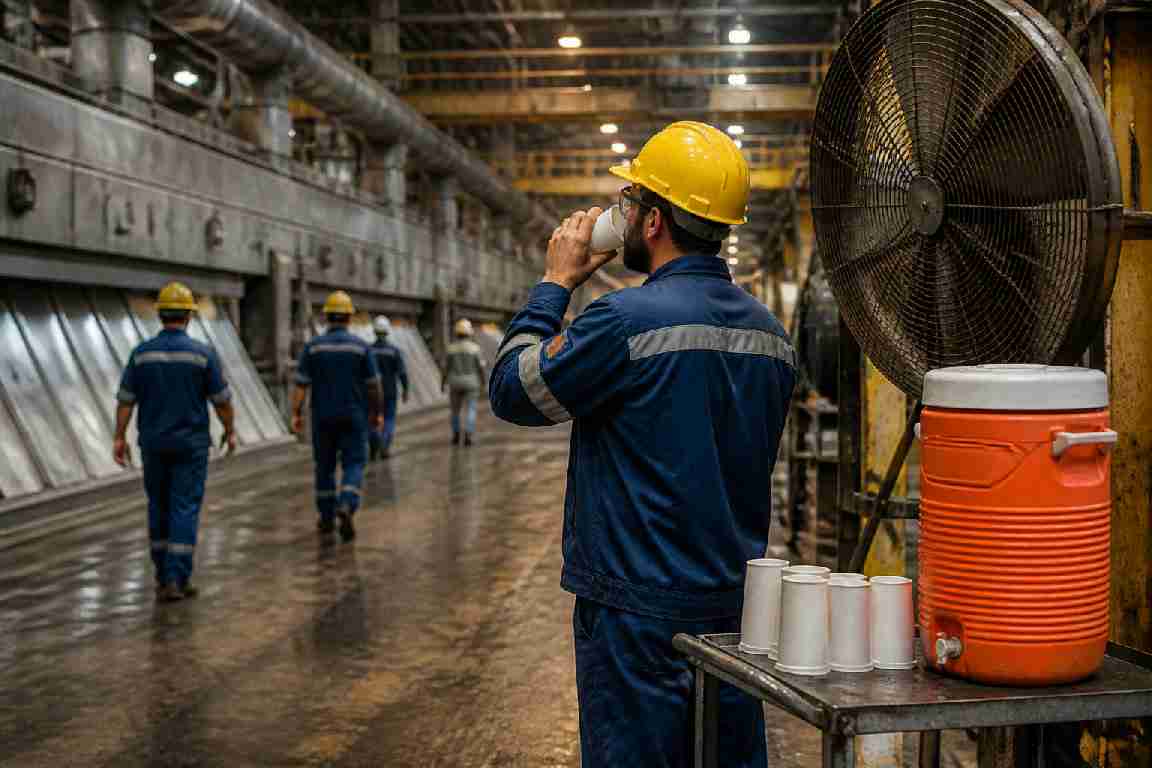
Heat stress is a physiological challenge that can lead to impaired judgment, fatigue, and physical collapse. In the context of occupational health and safety, these symptoms are precursors to more serious mechanical or fall-related accidents. Alba’s campaign addresses this by promoting hydration and proper nutrition, ensuring that workers are physically equipped to handle the demands of the smelting environment.
The campaign includes a series of workshops and presentations designed to help employees recognise the early signs of heat-related illnesses. For dutyholders and facilities managers, the lesson is clear: training should be timed to reflect the risks of the season. In the UK, while we may not face the same consistent extremes as the Middle East, the increasing frequency of summer heatwaves makes heat stress a growing concern for construction and manufacturing sectors.
Integrating wellness with safety is a strategy Al Baqali believes is essential. By treating worker health as an extension of the safety system, the company reduces the likelihood of absenteeism and long-term health issues. This holistic view of occupational health and safety ensures that the workforce remains resilient and capable of meeting the rigorous demands of aluminium production.
Practical steps for larger industrial dutyholders
For UK-based health and safety professionals, the Alba model offers several practical takeaways. First, the use of themed campaigns can help refresh stagnant safety messages. By focusing on a specific seasonal risk, the company prevents “safety fatigue” where employees begin to tune out generic warnings.
Second, the involvement of contractors in these campaigns is vital. Alba treats its contractor workforce with the same level of safety scrutiny as its direct employees. In the UK, the CDM Regulations and general health and safety legislation place significant responsibility on clients and principal contractors to ensure that everyone on site is protected, regardless of their employment status.
Finally, the data gathered during these periods can be used to refine future risk assessments. By monitoring how many heat-related interventions are required, management can make informed decisions about shift patterns, cooling station locations, and the provision of personal protective equipment (PPE) that is suitable for high temperatures.
The success of Alba’s campaign will be measured not just in the absence of accidents, but in the continued engagement of its staff. As the smelting industry continues to evolve with new technologies and automation, the fundamental requirement to protect the human element within the system remains the top priority. The annual summer initiative ensures that, even in the harshest conditions, the focus on safety never wavers.