Explore this post with your favourite AI tool:


Share this article with AI tools to summarise, remember, or explore the content further.
p>Implementing effective legionella prevention measures is a non-negotiable requirement for property owners and employers responsible for maintaining safe water systems. Failure to manage these risks effectively can lead to outbreaks of Legionnaires’ disease, a severe form of pneumonia caused by inhaling fine droplets of contaminated water.
Recent guidance for building owners highlights the critical importance of understanding where Legionella bacteria thrive. The bacteria naturally occur in low levels in many water sources, but they become a significant public health risk when allowed to multiply within man-made water systems, such as cooling towers, hot and cold water services, and spa pools.
For UK dutyholders, the focus remains on preventing the conditions that allow these bacteria to proliferate: stagnant water, temperatures between 20°C and 45°C, and the presence of nutrients like scale, rust, or biofilm. While the baseline requirements vary depending on the type of facility, the fundamental principles of risk management remain consistent across all sectors.
The role of risk assessments in legionella prevention measures
The first step for any business owner or landlord is to carry out a comprehensive risk assessment. This is not merely a box-ticking exercise but a practical evaluation of the water system to identify potential points of contamination or aerosol release. If you do not have the internal expertise to conduct this, the responsibility lies with you to appoint a competent person or external specialist.
A thorough assessment should map out the entire water system, identifying “dead legs” where water might sit stagnant and ensuring that thermostatic mixing valves (TMVs) are functioning correctly. It must also consider the vulnerability of the people using the building, as healthcare environments or care homes naturally carry a higher risk profile than a standard office block.
Once the risks are identified, they must be documented. For employers with five or more staff, keeping a written record of the assessment is a legal requirement. However, even for smaller businesses, having a clear paper trail is the only way to demonstrate compliance should an inspector from the Health and Safety Executive (HSE) or a local authority environmental health officer visit the premises.
Maintaining temperature control and system hygiene
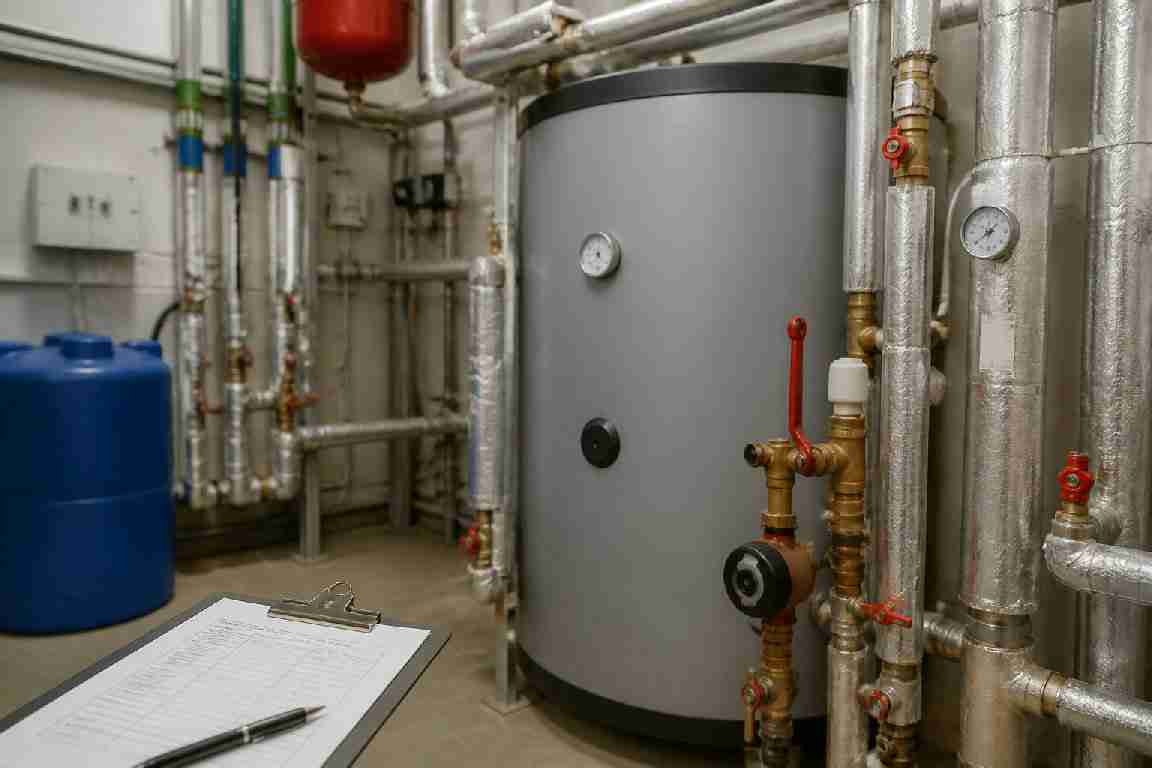
Temperature control is widely regarded as the primary method for ensuring legionella prevention measures are effective. Legionella bacteria struggle to survive in temperatures above 60°C and remain dormant below 20°C. Therefore, hot water storage cylinders should store water at 60°C or higher, and water should reach outlets at a minimum of 50°C within one minute of turning on the tap.
Conversely, cold water must be kept cold. This often involves ensuring that cold water storage tanks are well-insulated and located away from heat sources, such as boiler rooms or sunny roof spaces. If cold water pipes are run too close to hot water pipes without adequate lagging, the resulting “heat gain” can create a perfect breeding ground for bacteria.
Aside from temperature, physical cleanliness is vital. Water tanks should be inspected annually to check for signs of debris or corrosion. If a tank looks neglected, it likely needs cleaning and disinfection. Similarly, showerheads and spray taps, which are prime sources of aerosol generation, should be descaled and disinfected at least quarterly to prevent the build-up of organic matter that feeds the bacteria.
Managing stagnant water and low-occupancy areas
Stagnation is one of the biggest challenges in modern facilities management, particularly in buildings that are not fully occupied. When water sits in pipes for days or weeks, the protective chlorine residual provided by the mains supply dissipates, and biofilm begins to form on the internal surfaces of the pipework.
To combat this, a regular flushing regime must be established for all infrequently used outlets. This usually involves running taps and showers for several minutes at least once a week. In buildings such as schools during summer holidays or hotels during the off-season, these legionella prevention measures become even more critical to ensures the system is safe for return to use.
If a building or a specific wing has been out of use for an extended period, simple flushing may not be enough. In these cases, a full system disinfection might be required. It is also worth considering the permanent removal of redundant pipework to eliminate dead legs entirely, rather than relying on manual flushing which is often prone to human error or poor record-keeping.
Accountability and the “Responsible Person”
Legally, the responsibility for water safety sits with the employer or the person in control of the premises. This individual must appoint a “Responsible Person” who has sufficient authority, competence, and knowledge to ensure that all necessary precautions are taken. This role is pivotal; they must ensure that all maintenance tasks are carried out on schedule and that the results are logged accurately.
Compliance is not just about doing the work; it is about being able to prove it. A logbook—whether digital or physical—should contain the risk assessment, a description of the water system (such as a schematic diagram), and a record of all monitoring results, including temperatures, inspections, and any remedial work undertaken. These records should be kept for at least five years.
Ultimately, legionella prevention measures are about consistent vigilance. Outbreaks are rarely the result of a single catastrophic failure; they are usually the consequence of a gradual decline in maintenance standards or a lack of oversight. By maintaining narrow temperature windows, eliminating stagnation, and keeping systems clean, dutyholders can effectively manage the risk and ensure the safety of everyone entering their buildings.