Explore this post with your favourite AI tool:


Share this article with AI tools to summarise, remember, or explore the content further.
Developments in mining safety technology are now central to the industry’s drive towards ‘zero harm’, providing a digital shield for workers in high-risk environments. As the sector moves away from reactive safety protocols, these innovations are becoming essential tools for dutyholders managing complex underground and surface operations.
The push for safer mining operations has shifted significantly from manual oversight to automated, data-led interventions. While mining has historically been one of the most hazardous sectors for workers, the integration of Artificial Intelligence (AI), the Internet of Things (IoT), and wearable devices is fundamentally changing how risks are identified and mitigated on-site.
For health and safety professionals, this technological transition represents a move toward real-time risk management. Instead of reviewing incidents after they occur, site managers are now using predictive analytics to stop accidents before they happen. This shift is not just about adopting new gadgets; it is about creating a comprehensive safety ecosystem that connects every worker and piece of machinery to a central monitoring hub.
Recent developments have highlighted how mining safety technology can address the most common causes of fatalities and serious injuries, such as vehicle collisions, rockfalls, and exposure to toxic gases. By removing humans from the most dangerous areas through automation and providing better situational awareness via sensors, the industry is seeing a measurable impact on safety performance.
Integrating mining safety technology into daily operations
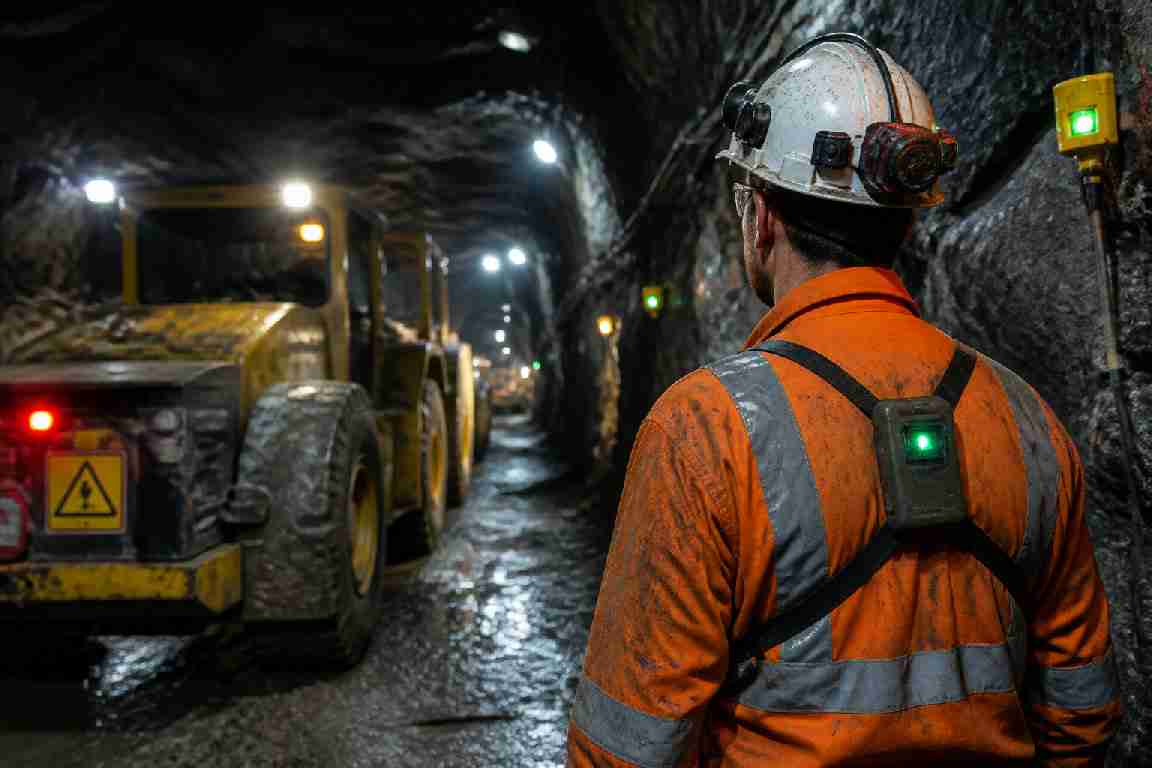
One of the most practical applications of modern safety systems is the use of IoT-enabled sensors. These devices can be fixed to structural supports, heavy machinery, or worn by personnel. When integrated into a single network, they provide a live map of the mine, allowing supervisors to see exactly where people are in relation to moving hazards.
Proximity detection systems (PDS) are a prime example of this in action. These systems use radar, GPS, or electromagnetic sensors to alert both vehicle operators and pedestrians if they are getting too close to each other. In a dark, noisy, and cramped environment, these automated alerts provide a vital layer of protection that goes far beyond simple high-visibility clothing and hand signals.
Beyond physical collisions, mining safety technology is also being used to monitor the long-term health of employees. Wearable tech can now track vital signs such as heart rate, body temperature, and fatigue levels. If a worker’s data suggests they are suffering from heat stress or extreme exhaustion, supervisors can intervene and pull them out of the line of fire before a lapse in concentration leads to an incident.
AI is also playing a larger role in geotechnical monitoring. By analysing data from seismic sensors and cameras, AI algorithms can identify subtle patterns in rock movement that might escape the human eye. This allows for earlier warnings regarding potential tunnel collapses or slope failures, giving teams more time to evacuate dangerous zones.
Compliance and the duty of care
From a compliance perspective, the adoption of these technologies helps dutyholders meet their legal obligations under health and safety legislation. In the UK, while deep-coal mining has diminished, the principles of the Mines Regulations 2014 and the Health and Safety at Work etc. Act 1974 still require employers to ensure, so far as is reasonably practicable, the health, safety, and welfare of their staff.
Using advanced mining safety technology provides a clear audit trail of risk management. When a safety manager can demonstrate that they have implemented real-time gas monitoring or automated collision avoidance, it shows a proactive approach to the “reasonably practicable” standard. Data logs from these systems also become invaluable during internal audits or in the event of an investigation by the Health and Safety Executive (HSE).
However, the introduction of these systems brings its own compliance challenges. Employers must ensure that staff are adequately trained to use new equipment and that the technology itself is maintained to a high standard. A proximity sensor that fails due to poor maintenance is arguably more dangerous than having no sensor at all, as it creates a false sense of security among the workforce.
The role of the ‘competent person’ is also evolving. Those responsible for safety must now understand not just the physical risks of mining, but also the digital infrastructure that supports it. This includes ensuring that communication networks underground are robust enough to handle the data flow required for these safety systems to function without interruption.
Practical implications for site management
For facilities managers and site owners, the primary hurdle is often the initial cost and the complexity of integration. However, the business case for mining safety technology extends beyond just preventing injuries. Reducing accidents also means reducing downtime, lower insurance premiums, and avoiding the massive costs associated with legal fees and regulatory fines.
Automation is perhaps the most significant shift for site management. By using remote-controlled drills or autonomous haul trucks, companies can keep personnel entirely out of high-risk areas. When a task can be performed from a control room on the surface, the risk to the worker is virtually eliminated. This doesn’t just improve safety; it often improves the efficiency of the operation, as machines can work in conditions that would be uncomfortable or dangerous for humans.
Environmental risk is another area where technology is making a difference. Real-time monitoring of ventilation systems ensures that air quality remains within safe limits. If sensors detect a buildup of methane or a drop in oxygen, the system can automatically adjust the ventilation or trigger an evacuation alarm. This level of responsiveness is impossible to achieve through manual testing alone.
As the industry continues to evolve, the focus will likely shift toward more integrated ‘smart mines’. In these environments, every piece of mining safety technology works in concert, creating a data-rich environment where safety is baked into the operational workflow rather than being an afterthought. For the modern dutyholder, staying ahead of these technological trends is no longer optional—it is a core part of the job.