
Explore this post with your favourite AI tool:


Share this article with AI tools to summarise, remember, or explore the content further.
The evolution of motorsport health and safety has shifted the focus from driver protection to a comprehensive view of team and spectator welfare. While high-speed crashes dominate the headlines, the day-to-day risks faced by technicians and support staff require equal attention.
Operating a professional racing team involves more than just speed; it is an exercise in managing a complex, mobile workplace under significant time pressure. From the temporary garages at a local circuit to the high-tech hubs of international series, the duty of care remains the same. Ensuring that every member of the crew returns home safely requires a move away from the “culture of risk” that has historically defined the paddock.
In the UK, the Health and Safety Executive (HSE) makes no distinction between a permanent workshop and a temporary trackside setup. If you are an employer or a person in control of a premises, the Management of Health and Safety at Work Regulations 1999 apply. This means risk assessments must be specific to the environment, acknowledging that a rain-slicked pit lane presents different hazards than a dry, well-lit factory floor.
Addressing latent risks and motorsport health and safety
One of the most overlooked aspects of motorsport health and safety is the management of long-term health hazards. While immediate physical injuries from tools or vehicle movements are obvious, latent illnesses caused by exposure to hazardous substances can be far more devastating. In the past, the industry relied heavily on materials that we now know to be lethal, including asbestos in brake linings and heat shielding.
Legacy issues continue to affect retired mechanics and engineers. Awareness of mesothelioma symptoms—a cancer often linked to historical asbestos exposure—is a vital part of health monitoring for those who worked in the industry during the 20th century. Modern teams must ensure they are not creating similar problems for the future by strictly controlling fumes, dust, and chemical exposure under COSHH (Control of Substances Hazardous to Health) regulations.
Noise is another pervasive issue. The acoustic environment of a race weekend is often well above the thresholds defined in the Control of Noise at Work Regulations 2005. It is not enough to simply hand out earplugs; teams need to consider the “hierarchy of control,” looking at how they can isolate staff from noise or use technology to communicate without further endangering hearing. Regular health surveillance for permanent staff is a sensible, and often necessary, step for compliance.
Fire safety and hazardous materials
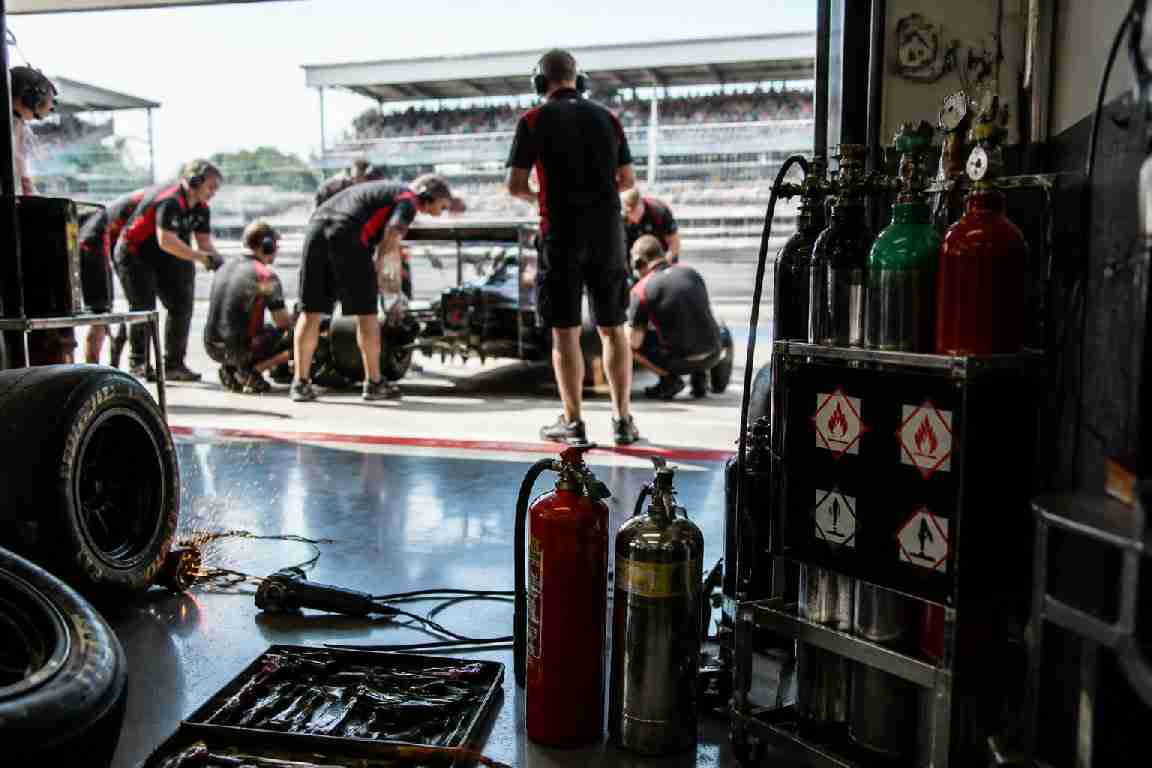
The presence of high-octane fuels, pressurised gases, and lithium-ion batteries makes fire safety a critical priority. A standard fire risk assessment for a static building will not suffice for a mobile race team. The “responsible person” for the team must ensure that fire-fighting equipment is not only present but suitable for the specific types of fires they might face. A water extinguisher is useless against a fuel spill or a battery fire.
With the rise of hybrid and electric powertrains, the risk profile has changed. High-voltage systems require specialist training and insulated tools. If a vehicle is involved in an incident, the “quarantine” procedure for a damaged battery is a logistical challenge that must be planned for well before the team arrives at the circuit. Failure to manage these risks could lead to devastating fires that threaten not just the team, but neighbouring competitors and the public.
Human factors and the pressure to perform
The relentless schedule of a racing season can lead to fatigue, which is a significant contributor to workplace accidents. In a high-stakes environment, the pressure to complete a gearbox change or a setup adjustment in minutes can lead to corners being cut. Managers must foster a culture where motorsport health and safety is seen as a facilitator of performance, rather than a hindrance.
Fatigued staff are more likely to make errors in judgement, leading to manual handling injuries or mistakes when working at height on transporters. Proper resource planning and ensuring adequate rest periods are not just about staff wellbeing; they are fundamental to operational safety. A team that treats its staff as high-performance assets will naturally invest in their safety and health monitoring.
Ultimately, motorsport health and safety is about professionalising the environment behind the scenes to match the precision seen on the track. Whether it is managing the risks of temporary electrical installations or ensuring that subcontractors are properly vetted, the responsibility lies with the leadership. By treating the paddock as a workplace rather than just a sporting venue, teams can ensure they meet their legal obligations while protecting their most valuable assets—their people.