Explore this post with your favourite AI tool:


Share this article with AI tools to summarise, remember, or explore the content further.
The impact of the stratford station fire serves as a stark reminder of how quickly external environmental hazards can disrupt critical infrastructure and workplace safety. For facilities managers and transport dutyholders, the incident highlights the ongoing challenges of managing fire risks in high-traffic urban hubs during periods of heightened environmental vulnerability.
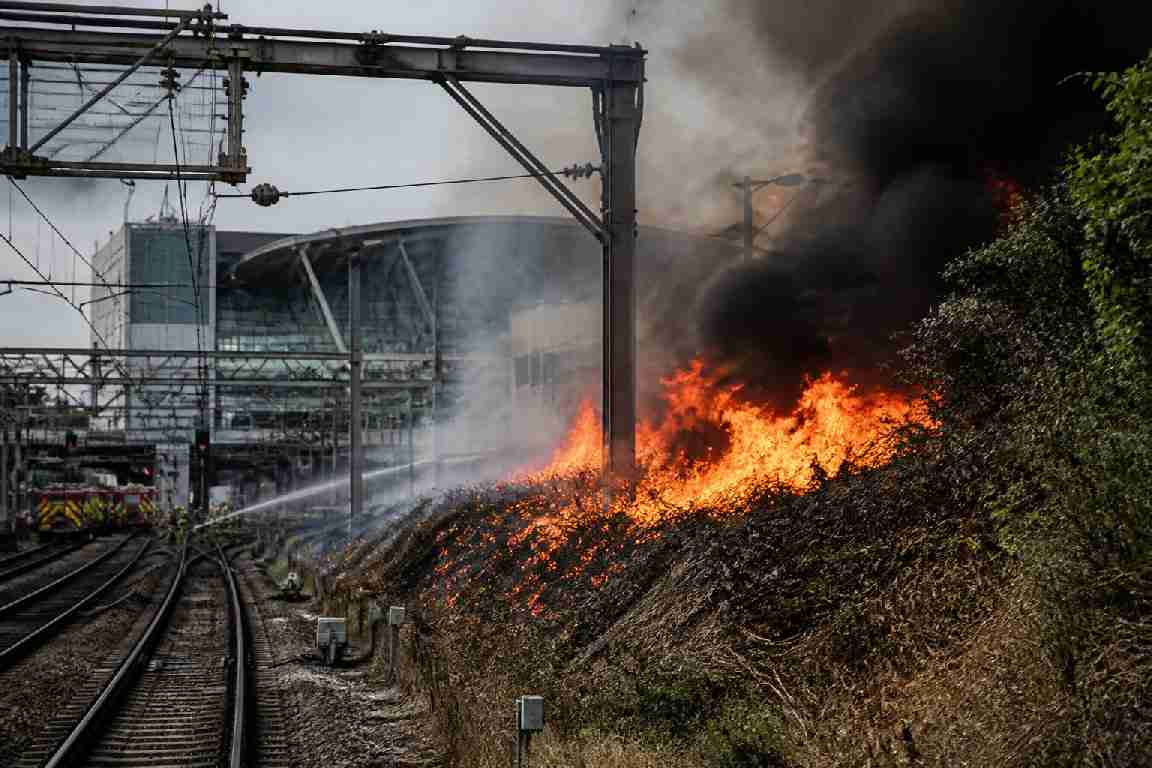
Emergency services were called to tackle a significant blaze near Stratford Station on Friday evening, leading to the immediate closure of one of London’s busiest transport interchanges. The incident, which saw London Fire Brigade (LFB) crews deployed to manage a fire in close proximity to the tracks, forced the evacuation of the station and caused widespread disruption to local rail and Underground services.
The fire broke out during a period of notably high temperatures, coinciding with official warnings regarding an “extreme” wildfire risk across parts of the UK. While the exact cause of the blaze is subject to investigation, the location near the railway line necessitated a swift response to prevent the flames from spreading to station infrastructure or live electrical equipment. Passengers were advised to avoid the area as thick smoke billowed near the platforms, creating visibility issues and potential respiratory hazards.
The stratford station fire and the rise of urban wildfire risks
This incident is not an isolated case of environmental volatility impacting built assets. The stratford station fire occurred against a backdrop of increasing concerns from the London Fire Brigade regarding how dry vegetation and high temperatures are creating “tinder-box” conditions in urban settings. For those managing commercial property or transport networks, the risk is no longer confined to internal electrical faults or arson; the external perimeter is now a primary zone of concern.
When fires occur near major transport hubs like Stratford, the priority for the “responsible person” under the Regulatory Reform (Fire Safety) Order 2005 shifts immediately to life safety and evacuation. The presence of large crowds, combined with the complexities of underground and overground rail interfaces, means that a fire in the immediate vicinity can be just as dangerous as one inside the building. Smoke ingress into ventilation systems and the heat impact on structural elements are critical factors that dutyholders must account for in their emergency planning.
The operational response to the stratford station fire involved not only extinguishing the flames but also ensuring that the railway’s high-voltage overhead lines were safe for firefighters to work near. This often requires a coordinated “power down” with Network Rail or Transport for London (TfL), adding layers of complexity to the incident management process. It underscores why communication protocols between property managers and utility providers are essential in any robust fire safety strategy.
From a compliance perspective, the stratford station fire highlights the need for site-specific fire risk assessments (FRAs) to evolve. Traditional FRAs often focus heavily on the internal compartmentation and fire detection systems. However, as the UK experiences more frequent periods of extreme heat, assessors must increasingly look outward. This includes evaluating the risk posed by railway embankments, neighbouring vacant land, or accumulated debris near the building envelope.
For facilities managers and building owners, managing the external environment is now a core part of property compliance. This involves more than just clearing gutters; it requires a proactive approach to vegetation management and ensuring that “defensible space” is maintained around critical entrances and air intake vents. If external fires can easily ignite materials or vegetation close to a building, the risk of fire spread into the internal structure increases exponentially.
The logistical fallout from the stratford station fire also brings business continuity planning into sharp focus. With the station closed, thousands of workers and commuters were displaced, and nearby businesses faced operational standstills. For employers in the area, this necessitates a review of their own emergency procedures—specifically, how they manage staff welfare and communication when a major transport link is severed due to a localized emergency.
Contractor management is another area where lessons can be drawn. If hot works or maintenance tasks were being carried out nearby, the threshold for “high-risk” activities must be lowered during peak heat periods. Ensuring that contractors are strictly adhering to permit-to-work systems and have adequate fire suppression equipment on hand is non-negotiable when the surrounding environment is as dry as it was during this incident.
As the investigation into the stratford station fire continues, the incident serves as a clear indicator that fire safety is a dynamic field. Relying on historical data or “standard” risk profiles is no longer sufficient for dutyholders responsible for high-occupancy buildings or infrastructure. The integration of local fire service warnings into daily operational checks during summer months is becoming a necessary step for maintaining safety and compliance.
Ultimately, the successful evacuation and containment at Stratford suggest that emergency protocols were effective, yet the disruption reminds us of the fragility of urban systems. For the health and safety professional, the takeaway is clear: fire risk management must be as adaptable as the weather patterns that are increasingly driving these incidents. Regular reviews of evacuation routes, external housekeeping, and inter-agency coordination remain the best defence against such unpredictable hazards.