Explore this post with your favourite AI tool:


Share this article with AI tools to summarise, remember, or explore the content further.
Managing the legionnaires disease risk at your property becomes significantly more challenging during periods of sustained warm weather as bacteria levels can spike.
Health experts have issued a fresh warning to property owners and facilities managers as temperatures rise across the UK, highlighting the increased danger of Legionella proliferation in water systems. The warning specifically focuses on the use of hot tubs and spa pools, which provide the ideal environment for the bacteria to thrive if maintenance regimes are not strictly followed.
Legionnaires’ disease is a severe form of pneumonia caused by inhaling aerosolised water droplets contaminated with the Legionella pneumophila bacteria. While often associated with large-scale cooling towers or complex plumbing systems in hospitals and hotels, smaller installations like domestic-style hot tubs in commercial settings are frequent sources of outbreaks.
Understanding the surge in legionnaires disease risk during heatwaves
The biological reality of Legionella is that it thrives in stagnant water between 20°C and 45°C. During a UK heatwave, ambient temperatures often push cold water storage tanks and pipework into this danger zone. When these temperatures are combined with the organic matter often found in hot tubs—such as skin cells, oils, and sweat—the bacteria have both the heat and the nutrients required to multiply rapidly.
For those responsible for building safety, the concern isn’t just the temperature but the delivery mechanism. Hot tubs are designed to create an aerosol through jets and bubbles. This means that if the water is contaminated, the equipment is essentially engineered to deliver the bacteria directly into the lungs of anyone in the immediate vicinity.
Public health officials have noted that many people underestimate how quickly water chemistry can fail. In high temperatures, chlorine or bromine disinfectants burn off much faster than usual. If a dutyholder is not increasing the frequency of their testing and dosing during a hot spell, they may be leaving their visitors and staff exposed to a significant legionnaires disease risk without realising it.
Practical maintenance for spa pools and hot tubs
From a compliance perspective, the Health and Safety Executive (HSE) provides clear guidance in HSG282 for the control of Legionella in spa pool systems. This isn’t just “good practice” for commercial operators; it is a fundamental requirement for demonstrating that you are meeting your legal duties under the Health and Safety at Work etc. Act 1974.
Effective management starts with a robust risk assessment. This document should specifically address the increased legionnaires disease risk posed by seasonal temperature changes. If your risk assessment hasn’t been reviewed recently, a period of extreme weather is exactly when you should be looking at it again to ensure your control measures are still fit for purpose.
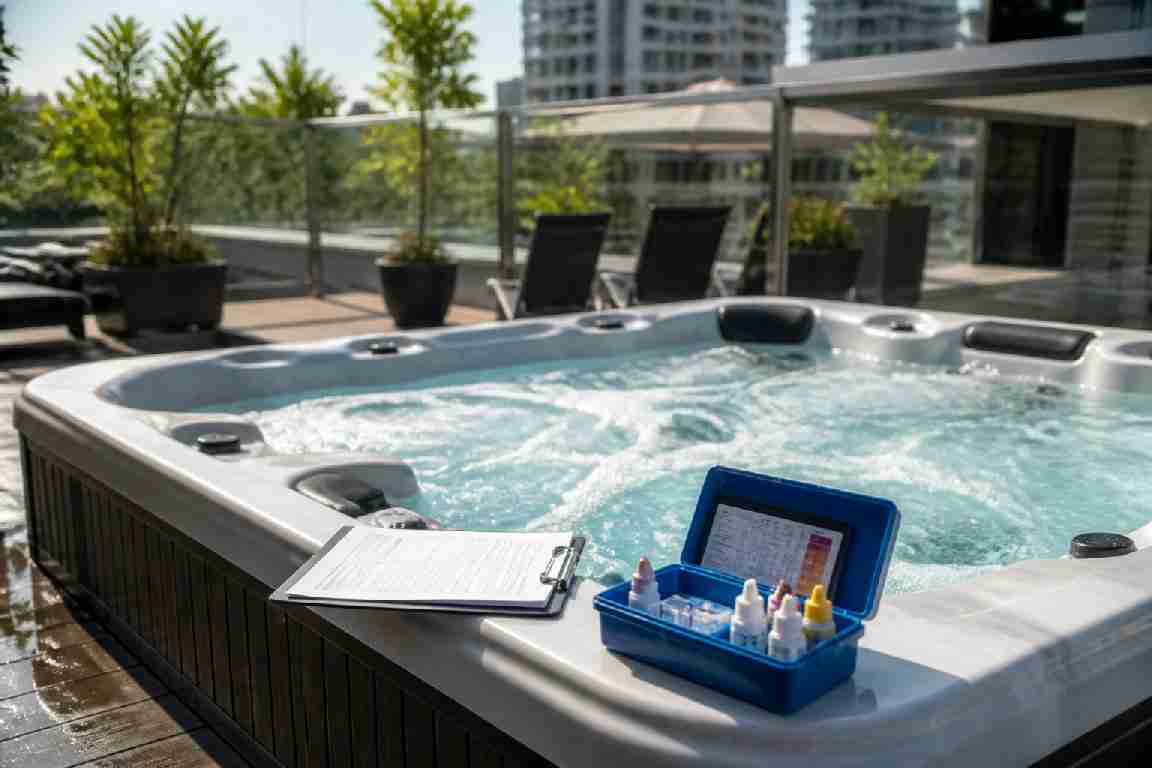
Daily checks are the backbone of safety for any hot tub or spa. This includes testing pH levels and disinfectant concentrations at least three times a day, or more frequently if the bath is under heavy use. Keeping a meticulous logbook of these readings is essential. In the event of an inspection or, worse, an outbreak, these records are the only way a responsible person can prove they were managing the system correctly.
The duty of care for landlords and employers
The responsibility for managing water safety doesn’t just sit with the person holding the testing kit; it rests with the dutyholder or the “responsible person” appointed to oversee the premises. In many cases, this is the business owner, the landlord, or a senior facilities manager. They must ensure that whoever is carrying out the maintenance is competent and has received adequate training.
Complacency is often the biggest factor in compliance failures. It is easy to view a hot tub as a simple leisure amenity, but from a health and safety standpoint, it is a high-risk piece of plant. If a system is left standing idle during the week and only used at weekends, the stagnation can lead to biofilm build-up. These films protect bacteria from disinfectants, making the legionnaires disease risk much harder to eradicate once it takes hold.
Beyond the testing, full system cleans and disinfections are required periodically. For commercial or shared-use tubs, this usually means a weekly drain and clean, alongside a quarterly “super-chlorination” to strip out any developing biofilms within the internal pipework that isn’t visible to the naked eye.
Wider implications for property compliance
While the current warnings focus on hot tubs, the principles apply to the wider building water system. Cooling towers, decorative fountains, and even infrequently used showers in office blocks can become hazards during a heatwave. If a building has low occupancy, for example, water can sit in pipes getting warm, creating a perfect breeding ground.
Facilities teams should be proactive in flushing “dead legs” and infrequently used outlets. If a shower hasn’t been used in a week, it should be run for several minutes to clear the standing water, ideally with the showerhead removed or covered to prevent aerosol release during the process. This simple act of manual flushing can significantly reduce the overall legionnaires disease risk across a site.
Monitoring incoming water temperatures is also vital. Usually, cold water should remain below 20°C. However, in a prolonged heatwave, the mains water entering a building can already be at a higher temperature. This requires a shift in strategy, perhaps relying more heavily on chemical residuals and more frequent turnover of water rather than just temperature control.
Ultimately, the threat of Legionella is manageable, but it requires consistent attention. As the UK continues to experience more frequent and intense heatwaves, the margin for error in water treatment becomes much smaller. For those managing property portfolios, ensuring that maintenance schedules are strictly adhered to—and adapted for the heat—is the only way to protect both the public and the organisation’s legal standing.